Contact information

Theodore Lowe, Ap #867-859 Sit Rd, Azusa New York

We are available 24/ 7. Call Now. (888) 456-2790 (121) 255-53333 example@domain.com
Follow us

Top Coats

Lubrication

PLUS® VL allows to obtain a stable and controlled friction coefficient in the range of 0.09-0.14.
0.09-0.14
Coefficient of friction (ISO 16047)

Corrosion protection

Combined with our zinc flake basecoats, PLUS® VL reacts and creates a barrier effect that improves both the corrosion resistance of the system and the contact corrosion with aluminum and other materials.

Chemical resistance

Resistance to industrial solvents and automotive fluids.

Color tracing

PLUS® VLh can be colored for part visual identification and differentiation.

No hydrogen embrittlement

Implemented via non-electrolytic application processes. This avoids the hydrogen embrittlement phenomenon that causes cracking of metals

Lubrication

PLUS® VLh allows to obtain a stable and controlled friction coefficient in the range of 0.09-0.14. It provides outstanding tribological performances and stability regarding multi-tightening with various counterparts materials (cataphoretic paint, aluminum alloys, cast iron and steel) while avoiding stick-slip problems. It also offers excellent behaviour in loosening tests, including at high temperature.
0.09-0.14
Coefficient of friction (ISO 16047)

Corrosion protection

Combined with our zinc flake basecoats, PLUS® VLh reacts and creates a barrier effect that improves both the corrosion resistance of the system and the contact corrosion with aluminum and other materials.

Chemical resistance

Resistance to industrial solvents and automotive fluids.

Color tracing

PLUS® VLh can be colored for part visual identification and differentiation.

No hydrogen embrittlement

Implemented via non-electrolytic application processes. This avoids the hydrogen embrittlement phenomenon that causes cracking of metals

Lubrication

PLUS® ML allows to obtain a stable and controlled friction coefficient in the range of 0.10-0.16. It provides outstanding tribological performances and stability regarding multi-tightening with various counterparts materials (cataphoretic paint, aluminum alloys, cast iron and steel) while avoiding stick-slip problems. It also offers excellent behaviour in loosening tests, including at high temperature.
0.10-0.16
Coefficient of friction (ISO 16047)

Corrosion protection

Combined with our zinc flake basecoats, PLUS® VLh reacts and creates a barrier effect that improves both the
corrosion resistance of the system and the contact corrosion with aluminum and other materials.

Chemical resistance

Resistance to industrial solvents and automotive fluids.

Color tracing

PLUS® ML can be colored for part visual identification and differentiation.

UV tracing

PLUS® ML can be functionalized with a UV tracer for part visual identification and differentiation.

No hydrogen embrittlement

Implemented via non-electrolytic application processes. This avoids the hydrogen embrittlement phenomenon that causes cracking of metals

Lubrication

PLUS® ML Black allows to obtain a stable and controlled friction coefficient in the range of 0.10-0.16 when applied on GEOMET® 321 or GEOMET® 720. It provides outstanding tribological performances and stability regarding multi-tightening with various counterparts materials (cataphoretic paint, aluminum alloys, cast iron and steel) while avoiding stick-slip problems. It also offers excellent behaviour in loosening tests, including at high temperature
0.10-0.16
Coefficient of friction (ISO 16047)

Corrosion protection

Combined with our zinc flake basecoats, PLUS® ML Black reacts and creates a barrier effect that improves both the corrosion resistance of the system and the contact corrosion with aluminum and other materials.

Chemical resistance

Combined with our zinc flake basecoats, PLUS® ML Black reacts and creates a barrier effect that improves both the
corrosion resistance of the system and the contact corrosion with aluminum and other materials.

No hydrogen embrittlement

Implemented via non-electrolytic application processes. This avoids the hydrogen embrittlement phenomenon that causes cracking of metals

Lubrication

PLUS® M allows to obtain a stable and controlled friction coefficient in the range of 0.12-0.18.
0.12-0.18
Coefficient of friction (ISO 16047)

Corrosion protection

Combined with our zinc flake basecoats, PLUS® M reacts and creates a barrier effect that improves both the corrosion resistance of the system and the contact corrosion with aluminum and other materials.

Temperature resistance

Combined with our zinc flake base coats, PLUS® M reacts and improves their temperature resistance by raising it to 400°C.

Chemical resistance

Resistance to industrial solvents and automotive fluids.

No hydrogen embrittlement

Implemented via non-electrolytic application processes. This avoids the hydrogen embrittlement phenomenon that causes cracking of metals.

Lubrication

PLUS® XL allows to obtain a stable and controlled friction coefficient in the range of 0.06-0.09, which is the lowest of our portfolio. It provides outstanding tribological performances and stability regarding multi-tightening with various counterparts materials (cataphoretic paint, aluminum alloys, cast iron and steel) while avoiding stick-slip problems. This topcoat is also perfectly adapted to torque + angle tightenings.
0.06-0.09
Coefficient of friction (ISO 16047)

Corrosion protection

Combined with our zinc flake basecoats, PLUS® XL reacts and creates a barrier effect that improves both the corrosion resistance of the system and the contact corrosion with aluminum and other materials.

Resistance to industrial solvents and automotive fluids.

Resistance to industrial solvents and automotive fluids.

No hydrogen embrittlement

Implemented via non-electrolytic application processes. This avoids the hydrogen embrittlement phenomenon that causes cracking of metals.

Lubrication

PLUS® L allows to obtain a stable and controlled friction coefficient in the range of 0.08-0.14. It provides outstanding tribological performances and stability regarding multi-tightening with various counterparts materials (cataphoretic paint, aluminum alloys, cast iron and steel) while avoiding stick-slip problems.
0.08-0.14
Coefficient of friction (ISO 16047)

Corrosion protection

Combined with our zinc flake basecoats, PLUS® L reacts and creates a barrier effect that improves both the corrosion resistance of the system and the contact corrosion with aluminum and other materials.

Chemical resistance

Resistance to industrial solvents and automotive fluids.

Color tracing

PLUS® L can be colored for part visual identification and differentiation.

No hydrogen embrittlement

Implemented via non-electrolytic application processes. This avoids the hydrogen embrittlement phenomenon that causes cracking of metals.

Lubrication

PLUS® 10 reacts and creates a barrier effect that improves both the corrosion resistance of the system and the contact
corrosion with aluminum and other materials.

Chemical resistance

Resistance to industrial solvents and automotive fluids.

No hydrogen embrittlement

Implemented via non-electrolytic application processes. This avoids the hydrogen embrittlement phenomenon that causes cracking of metals.

Lubrication

GEOMETPLUS® JL Blue allows to obtain a stable and controlled friction coefficient in the range of 0.14-0.20 when applied on GEOMET® 720 & GEOMET® 720HP. It provides outstanding tribological performances and stability while avoiding stick-slip problems.

0.14-0.20

Coefficient of friction (ISO 16047)

Corrosion protection

Combined with our zinc flake basecoats, GEOMETPLUS® JL Blue reacts and creates a barrier effect that improves both the corrosion resistance of the system and the contact corrosion with aluminum and other materialsResistance to industrial solvents and automotive fluids.

Chemical resistance

Resistance to industrial solvents and automotive fluids.

Lubrication

GEOMETPLUS® JL Black allows to obtain a stable and controlled friction coefficient in the range of 0.17-0.23 when applied on GEOMET® 321, GEOMET® 720 & GEOMET® 720HP. It provides outstanding tribological performances and stability while avoiding stick-slip problems.
0.17-0.23
Coefficient of friction (ISO 16047)

Coloration

Can get uniform black color by 2coats 2bakesCombined with our zinc flake basecoats, GEOMETPLUS® JL Blue reacts and creates a barrier effect that improves both the corrosion resistance of the system and the contact corrosion with aluminum and other materialsResistance to industrial solvents and automotive fluids.

Corrosion protection

Combined with our zinc flake basecoats, GEOMETPLUS® JL Black reacts and creates a barrier effect that improves both the corrosion resistance of the system and the contact corrosion with aluminum and other materials.

Chemical Resistance

Resistance to industrial solvents and automotive fluids.

Lubrication

The coefficient of friction of ECHOTE®WH700 is kept lower to drive screws faster.

Corrosion Protection

Combined with our zinc flake basecoats, ECHOTE® WH700 reacts and creates a barrier effect that improves both the corrosion resistance of the system and the galvanic corrosion protection with aluminum and different noble metals.

Chemical Resistance

Resistance to insecticide and fungicide agent for wood

Coloration

ECHOTE®WH700 can be colored for part visual identification and differentiation.

Scratch Resistance

ECHOTE® WH700 has a good scratch resistance performance against mechanical damaged areas.

Torquer Series

Preventing looseness / Cost reduction / Weight reduction The Torquer Series is effective in every situation
Increasing the size and number of bottles is not enough to prevent loosening.

Combined with our zinc flake basecoats, ECHOTE® WH700 reacts and creates a barrier effect that improves both the
corrosion resistance of the system and the galvanic corrosion protection with aluminum and different noble metals.

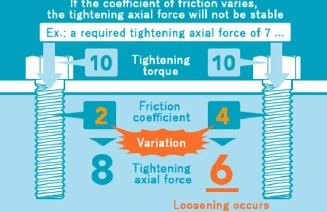
The most effective way to prevent loosening is to stabilize the coefficient of friction and exert an appropriate tightening
axial force.
01

Stable fastening axial force prevent looseness

When the friction coefficient is stable, it is possible to obtain a stable tightening axial force without any variation in all bolts when tightening with the same tightening torque.
02

A stable friction coefficient

Applying the Torquer Series reduces the variation in the friction coefficient and makes it stable. We offer 3 types of lineups that allow you to choose the one that suits your needs best.
03

Maximize the utilization of bolts without sacrificing performance

When the tightening torque is 20N*m, with M8 x 1.25 bolts (strength classification 6.8), only 7KN of tightening axial force can be obtained with non-lubricated bolts. However, when Neotorquer is applied, a tightening axial force of 17KN can be obtained
In this way the Torquer series can maximize bolt performance.
04

No more increasing the size in the number of bolts

Until now, it was necessary to increase the size and number of bolts in order to obtain the required tightening axial force. By using the Torquer series, more tightening axial force can be obtained. As a result, it is possible to reduce the size and number of bolts, thus reducing both the cost and the overall weight.When the tightening torque is 20N*m, with M8 x 1.25 bolts (strength classification 6.8), only 7KN of tightening axial force can be obtained with non-lubricated bolts. However, when Neotorquer is applied, a tightening axial force of 17KN can be obtained
Property

Zinc Flake

PTFE

Zinc
Thermal
Spray

Alkaline Zinc

Alkaline Zinc Nickel

Hot-Dip Galvanizing (HDG)

Application Method
Non-electrolytic (Dip-Spin/Spray)
Spraying, Coating
Thermal SprayingVery Good to Excellent (Cathodic/Ba rrier)
Electroplating

Electroplating

Immersion in Molten Zinc
Corrosion Protection Level
Excellent (Cathodic/Barrie r)
Good to Excellent (Barrier)
Very Good to Excellent (Cathodic/Ba rrier)
Good (Cathodic)
Superior (Cathodic)
Excellent (Cathodic/Barr ier)

Thickness
Range
($\mu$m)

Thin (5-15)
Varies greatlyGood to Excellent (Barrier)
Thick (50-500)
Thin (5-20)
Thin (5-15)
Thick (45-200)
Unique Selling Proposition (USP)
Absence of Hydrogen Embrittlement Risk (Ideal for high-strength steel fasteners)

Extremely
Low
Coefficient
of Friction
(Non-Stick)
& Excellent
Chemical
Resistance

Ability to Coat Extremely Large Structures On-Site
Exceptional Throwing Power and Uniform Coverage on Complex Parts
Highest Corrosion Resistance of Electroplated Coatings (Often >1000 hrs salt spray)
Metallurgical Bond & Most Cost-Effectiv e Long-Term Solution for Structural Steel